
- Comments (0)
- By PAUL P. JOHN
- August 31, 2026
- Total Reads: 29,138
The Catastrophic 1%: What Happens When Soil Loses Its Organic Carbon.
The Hidden Engine of the Earth
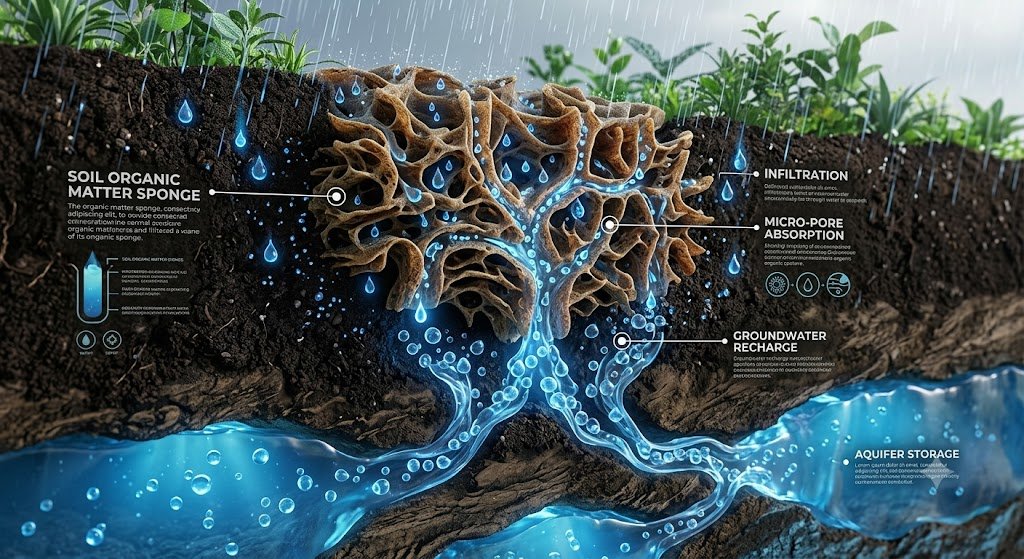
Soil is not just dirt. Healthy, living topsoil is a biological sponge held together by Soil Organic Matter (SOM)—a rich mix of decomposed leaves, root carbon, and microbial life.
While 1% sounds like a tiny number in human math, in the language of the Earth, a 1% loss of Soil Organic Matter is a planetary crisis.
Over the past few decades of industrial agriculture—driven by excessive tilling, monoculture, and chemical fertilizers—we have stripped away more than half of the earth's natural organic matter. Understanding what happens when we lose just 1% reveals how we unknowingly engineered world droughts, heatwaves, and toxic food.
1. The Water Collapse: Losing Millions of Liters per Acre
Soil Organic Matter acts like a massive microscopic sponge. Soil science shows that:
- For every 1% drop in Soil Organic Matter, one acre of land loses the ability to hold up to 20,000 to 25,000 gallons (approx. 75,000 to 95,000 liters) of water.
- On a 100-acre farm, a 1% loss of organic matter means the land loses the capacity to store nearly 7.5 to 9.5 million liters of natural rainwater.
What happens to the rain?
When the organic "sponge" is gone:
- Rain cannot infiltrate the hard, compacted earth.
- Instead of recharging underground aquifers, water washes off the surface, carrying away topsoil (erosion) and causing sudden flash floods.
- The moment the rain stops, the land dries into a desert, triggering severe agricultural drought within days.
2. The Total Ecosystem Breakdown
Losing 1% of organic matter sets off a domino effect across the entire biosphere:
- Microbial Extinction: Organic matter is the food source for beneficial soil bacteria, mycorrhizal fungi, and earthworms. Without it, the living soil microbiome dies, leaving behind a sterile mineral dust.
- Nutrient Starvation: Plants cannot absorb minerals directly from rocks or synthetic chemical bags; micro-organisms must process them first. As biological life dies, crops become nutrient-deficient, resulting in food that is high in calories but biologically empty.
- Soil Compaction & Erosion: Without carbon glue (glomalin) produced by fungi, soil turns to dust. Wind and rain strip away the remaining fertile topsoil.
- Thermal Stress & Climate Heating: Dark, organic-rich soil absorbs heat and regulates temperature. Exposed, organic-depleted soil acts like concrete, heating the local micro-climate and drying out atmospheric humidity.