
- Comments (0)
- By PAUL P. JOHN
- August 30, 2026
- Total Reads: 29,141
The Fragile Illusion of Food Security: Artificial Pollination & The Crisis of Monoculture.
The Collapse of Natural Synergy
Modern industrial agriculture claims to feed the world through efficiency, but in reality, it has engineered a fragile biological nightmare. By replacing natural biodiversity with vast stretches of Monoculture—growing a single crop over thousands of acres—we have systematically destroyed the natural habitat of bees, butterflies, and native pollinators.
To hide this ecological failure, the agro-chemical industry has introduced a temporary band-aid: Artificial Pollination. From handheld pollen dusters to mechanical drones and paintbrush techniques, humans are now attempting to manually do the work that nature performed for free for millions of years.
While artificial pollination may secure short-term yields, it conceals a dangerous biological breakdown.
The Severe Consequences of Monoculture & Hand-Pollination
1. Severe Genetic Erosion & Disease Vulnerability
Monoculture removes natural genetic variation. When millions of identical plants rely on manual pollination, any crop disease or pest can wipe out an entire food supply overnight, leaving no natural resistance.
2. Loss of Phytonutrient Complexity
Natural pollinators do not just transfer pollen; they interact with a plant’s micro-ecosystem, triggering stress responses that increase antioxidants and complex phytonutrients. Crops produced through artificial monoculture lack these complex protective compounds, yielding biologically weaker food.
3. Soil & Microbial Sterilization
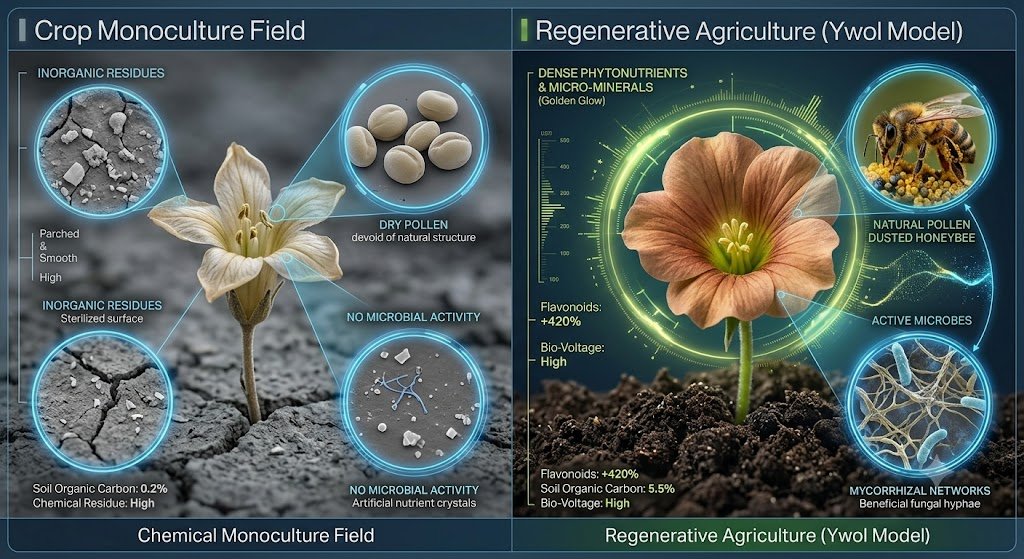
Monoculture relies heavily on synthetic chemicals to survive without natural ecosystem checks. These fertilizers kill mycorrhizal fungi and beneficial soil bacteria, depriving plants of vital micro-minerals.
4. Extreme Financial & Labor Dependency
Replacing natural ecosystem services with manual pollination inflates production costs, putting extreme pressure on farmers while making the global food chain dangerously fragile.
Monoculture vs. Regenerative Biodiversity
Monoculture & Regenerative
Artificial Pollination. Biodiversity . (Ywol Model)
Pollination High-cost Natural,
System manual/ self-sustaining
mechanical labor pollinator networks
Nutrient High High micro-
Quality. carbohydrates, minerals &
depleted complex
phytonutrients. antioxidants.
Ecosystem Fragile; high Highly resilient
Resilience risk of total to climate &
crop failure. pest shocks.
Cellular Impact. Increases Delivers clean
chemical load & bio-voltage
cellular & true
inflammation nourishment.
The Save Sapiens Call to Action
Artificial pollination is not progress; it is proof of ecosystem collapse. Manually brushing pollen onto a dying crop in a dead, chemical-soaked field will never replace the biological harmony of living soil and natural biodiversity.
At Ywol Regenerative Farmers, we advocate for a complete return to multi-crop ecosystems, living topsoil, and natural habitat restoration. Real food security begins when we stop replacing nature and start letting nature thrive.
Stop artificial fixes. Rebuild living ecosystems.
Join the Ywol Movement.... www.savesapiens.com