
- Comments (0)
- By PAUL P. JOHN
- August 21, 2026
- Total Reads: 29,128
The Silent Food Producers: Why Killing Pollinators Destroys Global Food Security.
When we talk about global food production, we usually imagine tractors, farmers, and vast agricultural fields. But behind 35% of the world’s daily crop production lies a silent, unpaid workforce: Natural Pollinators.
From honeybees, native beetles, and butterflies to hummingbirds, bats, and small mammals—these creatures are the fundamental
engine of planet Earth's biodiversity.
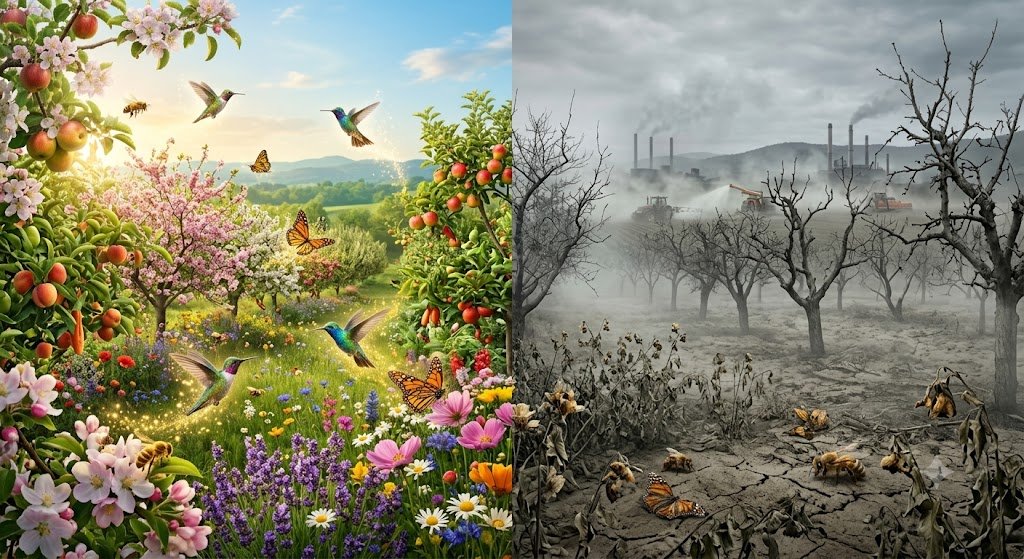
By drenching our farmland in synthetic chemical pesticides and systemic insecticides, modern industrial agriculture is systematically exterminating these essential creatures—pushing humanity toward an inevitable food crisis.
1. The Biological Engine of Food Security
Pollination is not just a passive natural phenomenon; it is the core biological interaction that sustains human nutrient intake.
Nutritional Dominance: Over 75% of the world's flowering plants and nearly 35% of global food crops rely directly on animal pollination.
High-Value Nutrition: The foods that depend most on pollinators are not empty calories like wheat or rice, but essential, nutrient-dense foods: fruits, vegetables, nuts, and oilseeds.
Economic Collapse: Without natural pollinators, food yields will plunge, triggering severe supply shortages, hyper-inflation in food prices, and global malnutrition.
2. Chemical Warfare on Pollinators
Systemic pesticides, particularly neonicotinoids and heavy chemical sprays, do not stay confined to target pests:
Neurological Sabotage: Pesticide residues contaminate pollen and nectar. When bees ingest these synthetic chemicals, their central nervous systems are sabotaged—causing memory loss, inability to navigate back to hives, and sudden colony collapse.
Destruction of Ecological Balance: Pollinators serve as indicator species. When chemical agriculture wipes out wild bees and bats, the entire local food web collapses, stripping ecosystems of their natural resilience (0V balance).
3. Preserving Biodiversity for Human Survival
Pollinators are fundamentally preserving the living matrix of biodiversity. Restoring their habitat is not an ecological luxury—it is a matter of human survival.
Stop Chemical Pesticides: Shift to biological pest management and eliminate toxic sprays that poison nectar and pollen.
Practice Regenerative Agriculture: Plant diverse cover crops and maintain natural floral corridors to provide year-round food and shelter for native pollinators.
Protect Living Soils: Healthy, unpoisoned topsoil fosters ground-nesting wild bees and maintains biological equilibrium.
"If the bee disappears from the surface of the Earth, man would have no more than four years left to live. Stop poisoning the silent guardians of our food." —
Paul P. John ,founder ywol movements.